Showing posts with label Coopers Hawk. Show all posts

Saturday, January 28, 2017

Duck, Duck, Black Duck

Today was one of those rare visits to the park where I actually found what I was looking for –or somewhat expected to see. For the past few years I've been able to locate an American Black Duck or two mixed in with the Mallards in the duck pond on the southwest corner of the park. I scanned the group looking for anything darker than usual and sure enough there was one there. I shared one of these images with other bird watchers on the Minnesota Birding facebook group and some quickly pointed out that the bird was not a full fledged Black Duck, but a hybrid with a Mallard. There were a few reasons but the one that resonated most with me is that this bird actually showed some white on the edge of the speculum (blue wing patch) which shouldn't be visible on an American Black Duck. I suppose I can agree with that but for my own purposes I'm still counting this as a Black Duck versus a Mallard mostly because the bird is just waaaay darker in overall appearance, and has other Black Duck traits such as the olive colored bill. In fact in this next photo where you can see a female Mallard in the background, you can see just how different looking this bird is. Anyway, about the only other bird of interest I saw was this adult Cooper's Hawk. As a bird watcher it can be a constant challenge to differentiate Cooper's Hawks from Sharp-shinned Hawks as they tend to look so similar. I'm basing some of my ID on the fact that this bird seems to have a "dark cap" on the top of the head which stops there, whereas the dark area on a Sharp-shinned would continue down the neck. Tough to tell for sure in this particular image though. Oh, and the strange Muscovy X Mallard Hybrid was also still among the Mallards.

Sunday, August 31, 2014

Last Day of August 2014

I can't believe how fast the month of August has gone by. It's actually been a good month for bird watching though I typically think of August as slow and quiet –second only to maybe January. And having a new lens to capture things through has also helped motivate me to be out more too. I was not disappointed again this Sunday morning. The first thing I noticed right after parking was a trio of Hawks who appeared to be playing and practicing their aeronautic skills. I don't often see two together much less three, so I followed them around for a bit. They were young Cooper's Hawks and I'm guessing they were likely a family that were born in or near the park this year. At one point all three perched in the same dead tree but only two were close enough to get in one photo. Not much later I spotted a Green Heron again in the little pond near the south parking lot. I had a good look and photo opportunity but I'm not posting it here today as I saw a variety of other interesting things. When I got to the two dead Tamarack trees on the south wood chip trail, I could see there was a lot of bird activity in the area. One bird that caught my eye right away was this one with a white eye-ring which I believe to be a Nashville Warbler. This is a plentiful warbler in the spring but for some reason I've only spotted them at the park during fall migration. I thought it seemed a bit early but indeed Fall Migration has already begun for many birds near the 3rd week in August. The next Warbler presented itself in much better light in the same area but down near eye level. This Common Yellowthroat is clearly a male due to it's black mask but does not look quite like the others I've seen this summer. My Stokes Field Guide to Warblers indicates it as a "Fall immature male." I really love how this photo turned out except for the one little twig cutting in front of the bird. It otherwise would have been up there in my best photos of the year. And if a "Fall immature male" wasn't enough, I also spotted a Black-and-white Warbler today which very clearly means that birds are heading back south again. I had a tough time catching a photo of this one as it bounced crazily from one place to the next just as they do in the spring searching for caterpillars and insects. This one had quite a bit of white coloring versus black meaning that it could either be a female or possibly another immature male. Black-and-white's are one of my favorite Warblers as they are so distinct in color and behavior from other Warblers. Though they forage at a ferocious pace like others, they are the only Warbler to walk up and down –and often upside down– on a bare tree trunk, much like a Nuthatch does. Oh I almost forgot but on the north side of the park today I spotted a HUGE frog sunning himself right out on the paved trail. I haven't seen a frog this large in quite some time. It was about as big as my hand. Because of this I thought maybe it was a Bullfrog. But later I learned that Bullfrogs are found only in southeastern Minnesota in Winona and Houston counties. It took a fellow flickr user to point out that this was a "Green Frog" which is Minnesota's 2nd largest frog. The main distinguishing factor was that this frog had "lateral folds" of skin along it's back, which a Bullfrog does not have. And I also learned that a Green Frog is not always green in color as it's name implies. While taking photos, a biker came along and I wanted to make sure the frog didn't get run over. The biker stopped to have a look and the frog suddenly hopped right through the spokes in the rear wheel of the bicycle and into the grass. I wanted to share one last photo here of a Wood Duck on the east side. He was perched in a dead branch above the little pond there and I snuck my way into the woods just far enough to get a look without scaring him off. This year I've learned that what may look like a juvenile male could also be a mature male in what is called "eclipse plumage" which is a fancy name for non-breeding plumage. Meaning that after breeding age they start to lose some of their brilliant coloring. I'm no expert but after studying my Stokes Guide I would say that this duck is still a juvenile but quite far along. It still has indications of a light eyebrow or streaking behind the eye which should not be visible on an adult.

Monday, May 26, 2014

Memorial Day 2014

Memorial Day is always seen as the "official" kick off to the Summer season and today it surely did feel like summer. It was warm and humid and felt more like a July day than late May. I didn't get to the park today until just after 4:30pm. But once I got there it was so beautiful I spent a long time making my way around the entire loop. I have more pictures than I can possibly post here today so I've picked a handful that represent some of my more fun sightings. The first was an unexpectedly close encounter with a beautiful Cooper's Hawk. It bumped out of a tree merely feet above me over the paved trail on the south side. It didn't go far and perched again in another shorter tree allowing me a very good look. I assumed it was a Cooper's Hawk right off the bat due to the very long, banded tail. But later upon looking at the photo more closely I realized it's breast was not the orangy-banded pattern I am used to seeing. I shared this photo on the Minnesota Birding Facebook page and someone pointed out that it is likely a first-year bird and has not grown it's full adult plumage yet. My second sighting of note was a fun one and I took a LOT of photos. Along the woodchip trail on the southwest corner, I noticed a Red-bellied Woodpecker land at the same spot on the same tree more than once. Upon looking closer I noticed a little hole in the side of the tree and then the Woodpecker disappeared into it! Sure enough it had a nest here and was busy feeding it's young. First the male landed with a mouthful of food and slipped inside the hole. When he came back out, I could plainly hear the loud squealing of little ones inside the tree. Then the female came in only seconds later with another mouthful of bugs and caterpillars. I watched this repeat once more before finally moving on. I ended up seeing a lot of good birds today but I had quite a good photo opportunity on the north side along the straight, paved trail. There hopping around in the small Willow shrubs was a female American Redstart. She was staying mostly near the ground and seemed to be searching for insects. I tried to predict where she might land next and it paid off as she hopped up on this small branch right in front of me! It is probably the single best photo of any Redstart I've ever gotten –not to mention a female too. I read somewhere later that the female American Redstart is somewhat unique among the Warbler family in that she does not vocalize (sing or call). And furthermore if you see what you think is a female Redstart and it it singing, then it is most likely a first-year male –who's plumage can look similar to the female when still young. I never knew that! One more photo I took not too much further down the trail was yet another female bird, this time a female Rose-breasted Grosbeak. She was busy gathering nesting material and in my first few shots she actually had a bill full of fine twigs. But as I watched, she must have decided against them for some reason, or inadvertently dropped them. You've gotta appreciate birds sometimes simply for the fact that they can construct intricate nests without the use of any limbs. I did not see the male anywhere around but I'm glad to know that this species may possibly be nesting in the park! Other notable sights spotted this evening included; American Goldfinch, Least Flycatcher, Great Crested Flycatcher, Question-mark Butterfly chasing a Red Admiral Butterly, Black-capped Chickadee, Yellow Warbler, Tree Swallow, a few Deer, Cedar Waxwing, Baltimore Oriole and Brown Thrasher. Oh, and a couple Morel Mushrooms!

Saturday, March 29, 2014

First Red-winged Blackbirds of 2014

Though I've seen that other people have been spotting Red-winged Blackbirds already (further south), I have not seen any yet this year at Palmer. But with the sun out today and temps finally staying above freezing now, I pretty much new that this Saturday I would have a good chance. And before I'd even walked very far the parking space at 73rd Avenue, I heard a loud squeaking that wasn't very familiar. This was not the long, scratchy call that is more common so I had to follow the direction of the sound. Sure enough, high up in the trees on the north side was a RWB -the first of the year for me. Over the last few years I've come to measure the true beginning of spring more by this event than by the calendar itself –and boy was it a welcome sight and sound this year! The photo here is not of the first one I spotted but one of many more as I made my way around the trail. Soon their numbers will increase dramatically enough to nearly drown out the sounds of other birds. The males are always the first to arrive and it is also noteworthy to record when I first spot any females. On the northwest corner I spotted this bright red Cardinal who seemed OK with me inching closer and closer for a photograph. Up until this past winter I was never satisfied with any of my Cardinal shots but this is probably one of the better –if not the best– I've taken so far. I've always wanted to capture one against a white background with snow falling but I am totally fine with waiting another year for that!!! Shortly after the cardinal I spotted a raptor zooming overhead so I tried to catch a photo. I could see with my naked eye that it's tail was longer which points to a Cooper's Hawk (or maybe a Sharp-shinned) but either way it was NOT a Red-tailed which are somewhat more common. This photo is cropped way in but I think it's kind of a neat photo and you can see some detail here of what I'm pretty certain is a Cooper's Hawk. The banding on the tail is quite distinct. I recently learned one tip to distinguish a Cooper's from a Sharp-shinned whey they are soaring overhead. A Cooper's will flap it's wings slower and make larger sized circles while the SS will flap a little faster and turn in noticeably smaller circles.

Saturday, February 15, 2014

Great Backyard Bird Count 2014

This Saturday morning I had an extra reason to hike around the park. Yesterday through Monday is the annual 2014 Great Backyard Bird Count. This count is a joint venture between the Cornell Lab of Ornithology, The Audubon Society and Bird Studies Canada. Furthermore it is powered by a widely used online reporting website called ebird. Since becoming a full-fledged bird geek in recent years, I've participated in both this count as well as what is called the annual "Christmas Bird Count." I've gotta say that I prefer the Great Backyard Bird Count or "GBBC" as it is just all around an easier commitment to make. Whereas with the Christmas Bird count you are encouraged to go out in groups, cover a LOT of ground –much of it by car– AND have a designated expert in identification among your group, the GBBC essentially lets you do everything on your own. You can cover as little or as much ground you like, and in fact you could do it from your window without even leaving home! So for at least one day a year in February, I like to be a little more fastidious when I'm out bird watching so that I can report my results. I did have a little help from a friend today in doing so, though we didn't make it all the way around the park. With the temp being at only 5 degrees above zero, and with my lower back still bothering me, we only hiked about half the trails. Probably the highlight though was a Hawk that we spotted not too far in from the trail. At first I thought this was a Red-tailed Hawk but upon closer look and seeing a long, bared tail we concluded it is a Cooper's Hawk. We also saw a fairly large flock of House Finches in the same area and were wondering if maybe the Hawk was watching them as well. The other most interesting thing we spotted could unfortunately not be counted as it was dead! Some time earlier another park goer stopped to ask us "what kind of feathers were these?" We both thought they looked like Pheasant feathers. Then later we started noticing more similar feathers laying on the trail. My friend then spotted a dark spot about 10 feet off the trail. There laying mangled in the snow was indeed a rooster Pheasant. Our first though was that it was likely attacked by a Great Horned Owl. So we looked for "wingtip imprints" in the snow and sure enough there they were. These are hard to take a photo of and so I passed on that. But I do have some photos of it here in an older blog entry. Whatever did kill this Pheasant didn't stick around long enough to consume everything it could. There was lots of it left. This is kind of a disturbing photo, but you can see some of what the Pheasant had eaten in it's lifetime.

Following is our bird count report submitted to ebird.org.

Palmer Lake Park, Hennepin, US-MN
Feb 14, 2014 9:30 AM - 10:50 AM
Protocol: Traveling
2.0 mile(s)
Comments:     5 degrees above zero, snow heading in soon.5 species

Cooper's Hawk  1
Downy Woodpecker  2
Hairy Woodpecker  1
Black-capped Chickadee  5
House Finch  35

View this checklist online at http://ebird.org/ebird/view/checklist?subID=S16956735

This report was generated automatically by the Great Backyard Bird Count (http://gbbc.birdcount.org)


Sunday, April 21, 2013

A Dreary Day in April but Good Birding!

After losing only about 2" of our recent snowfall, the sun went away today thus making Spring seem all the more unattainable. I wasn't quite as motivated to get out to the park today but I dragged myself anyway, knowing that despite looking and feeling like February, the birds know that it's actually late April! In the end I was very glad I went as I saw nearly 30 different species including: Mallard, Ring-necked Duck, Canada Goose, Ring-billed Gull, American Robin, Hermit Thrush, Black-capped Chickadee, Downy Woodpecker, Blue-winged Teal, Hooded Merganser, American Coot, American Tree Sparrow, Song Sparrow, Cooper's Hawk, Wild Turkey, Northern Cardinal, Blue Jay, Red-winged Blackbird, Dark-eyed Junco, American Crow, American Goldfinch, House Finch, Wood Duck, Yellow-rumped Warbler, Ruby-crowned Kinglet, Ring-necked Pheasant, Mourning Dove AND I distinctly heard Sandhill Cranes for the first time ever at the park! I never saw them but I heard them long enough to assume they had at least stopped somewhere in the park for a bit versus flying over. I took quite a few photos today so here goes. First was the Ring-necked Duck which was a great way to start off. I was very surprised to see one in the "Duck pond" which is the western most body of water in the park. In fact it was both a male and female which is exciting because I can't positively say that I'd seen a female Ring-necked before. I tried getting closer but of course as I did the pair swam further away from me. I decided to sit for a while but by the time I finally found a dry fallen tree, they decided to fly up over me and head into the middle of the park. That led me to the other side of the waterway where I quickly noticed both a Blue-winged Teal along with some Coots very near each other. Coots aren't much to look at but they are quite fascinating if you ever get to see them out of the water. Walking on land they appear much more like a chicken than a duck. These were the first ones I'd seen at the park this year but seeing the Teal there was of much more interest to me. I don't know very much about them but they are quite beautiful even though on the water you cannot even see the "blue wing" for which they are named. That portion is tucked away on the upper inside portion of their wing. As the Teal quickly swam back towards the middle of the park I again found a dry place to sit for a while, hoping he and other ducks might come back around the corner if I waited long enough. As I sat there I noticed my friend from yesterday, the Hermit Thrush bouncing around along the ground to my right. Of course I couldn't help but follow him too as he flew back and forth between the bare ground and some low trees. Once he perched on the side of a tree trunk kind of like a Nuthatch does which was something I didn't expect him to do. Finally as I moved around quietly he came to perch in a tree just slightly above my head and I had a nice clear view of him versus when he was on the ground and blending in. They are quite a beautiful bird and I hear they have a wonderful song though I've yet to hear one make the slightest peep so far. After this I continued up the wood chip trail where ahead of me I could see a commotion of two large birds. They were clearly raptors of some kind but I mostly could only see their light colored under sides. One of the two then swooped out straight towards me and then upward to land in a fair sized nest high up in the trees. This was the same nest I'd seen Cooper's Hawks in two years earlier. I could only see the tip of the tail over the edge of the nest so I decided to keep going and see if I could get close to the other one. The other had pretty much stayed in the same place but was kind of flapping about precariously trying to find a bigger branch to hold it's weight. Even from a distance I could see it's bright rusty breast and distinct red eyes, confirming they were indeed Cooper's Hawks. Quite an exiting sight -especially since they appeared to be preparing a nest! On the north side I was hurrying along in hopes that I might get to see some Sandhill Cranes that I could hear faintly but distinctly. I didn't know where to look but as I scanned back and forth I caught a glimpse of one lone Wild Turkey to my right. It was in the vicinity of where I think one had nested last year which made me wonder if it was scouting out a sight. Shortly later I ran into another park goer who said she just saw a pair of Turkey hens so I assume this was one of the two she saw. She mostly had her back to me but eventually turned and headed to the right away from me. The last thing I photographed today was a male Red-winged Blackbird who along with a group of others was making quite a racket. I've still not seen any female Red-wings yet but I assume they are here in small numbers or maybe they're just not as visible yet. The females do tend to blend in way better and it seems like they stay near the ground or near the bottoms of the cattails more. This male tolerated me being quite close to him and I waited until he belted out a loud raspy call for this photo. Every time they call it looks like they put every ounce of energy they have into it as they throw their shoulders and head back, thus showing off their bright shoulder patches. Palmer Lake Park would not be the same without Red-winged Blackbirds.

Sunday, July 15, 2012

Sunday Stroll


This Sunday morning I arrived at the park just after 8am and was once again seeing lots of American Redstarts. They were high up in the trees today and making me realize how tough it is to see them near the ground as I did yesterday. I wanted to check on the "re-built" Cooper's Hawk nest today and was happy to see at least one chick peering over the edge of the nest. With all the activity surrounding this nest lately I really hope at least one of them makes it into adulthood but only time will tell. I don't remember exactly where I saw this Common Yellowthroat. They are very very common at the park, but yet another common Warbler that can be hard to catch a good photo of. Like the American Redstart, the Common Yellowthroat doesn't seem to want to come out into the open very much, preferring to hide in thickets near cattails or among the cattails themselves. You'll most always hear a Yellowthroat before seeing it as they are quite loud for such a small little bird. They have a great and easy to remember call and I've had a fair amount of success attracting them closer by using recordings from my iphone -and even my own poorly imitated whistles. I've really come to associate their sound with the warm summertime. You can hear their sound and a lot of other birds on the Cornell Lab of Ornithology site Common_Yellowthroat/sounds. They say that birds often have different "dialects" in different areas and I would have to agree because the recording at this link sounds different than the Yellowthroats I hear every day at the park. The pitch or tone is the same but the emphasis and tempo are different. Later on towards the end of my walk I could see a Northern Flicker up ahead on the ground along the edge of the paved trail. Flickers apparently love to eat ants right off the pavement and they spend a fair amount of time on the ground. After I tried to sneak up behind him he flew just a little ways up into a tree and I was able to catch him before he went up even higher. This one is a male as he has a black "mustache" marking behind the bill whereas the female has no markings here at all.

Sunday, July 8, 2012

Cooper's Hawk Chick Rescue!

I had no idea of the adventure that awaited me today when I arrived at the park. I'd arrived quite early in the morning just before 8am to beat the heat as much as possible. In only the first few minutes I'd seen or photographed Yellow Warblers, Common Yellowthroats, Baltimore Orioles, Cardinals and lots of Goldfinches. But my mood was soon struck down when I noticed something white and fuzzy laying right on the paved trail. It was a young Hawk Chick and was unfortunately dead though it seemed to not have happened all that long ago. I wondered how it came to be laying on the trail and then I realized to look upwards. Straight up above me was a large nest in tatters with an adult Cooper's Hawk perched nearby. I thought what a bummer that this chick had apparently fallen right out of the nest and likely hit the pavement below. I started taking some photos of the adult Hawk who flew off moments later. As I looked at the nest -or what was left of it, I noticed one more fuzzy white body moving around in there somewhere. At least one was left but man, that nest was precarious as could be. I went to take another look at the dead chick on the trail and felt how sharp it's talons were -nearly like the tip of a needle. As I was looking I just barely noticed another white clump of downy feathers only a few feet away and further into the weeds. Oh no I thought -another one had fallen out! Then I noticed it breathing. I quickly used my phone to dial another member of Friends of Palmer Lake Park who happens to have quite a bit of experience with bird rehabilitation. While I waited for him to arrive with gloves and towels, I called the Raptor Center of Minnesota and was surprised to have a real person answer the phone! We exchanged information and called back after a while once we had the chick safely in the box with towels. Over the phone they helped us assess the situation, the bird's condition and even the condition of the nest it apparently fell from. For a number of reasons, the Raptor Center decided the best course of action was to track down a tree climber who could come out to the park, restore the nest and then return the chicks to it. With my inexperience in this area, that really seemed like a long shot to me. The nest was a good 60 if not 70 feet up in a Boxelder Tree that wasn't all that big around. On top of that it was Sunday morning and the likelihood of finding a climber within a short time seemed slim. Nevertheless, I went along with the plan to take the chick home to my house and wait until being contacted by a climber. It was a bit nerve-wracking, driving it all the way home trying not to jar it around too much in my truck that rides like a brick on wheels. Our resident bird rehab specialist who'd come out to help explained that sometimes it takes 4-5 hours or even a whole day to track down a climber who is available and in the area. So I had no idea how long I was going to have this bird in a box but worried that the longer we waited the less chance it had. Then in a stroke of luck less than an hour later, I received a call from a tree climber named Jim who was not only close but available to tackle the project in just one more hour. I gave him directions to the nearest place to park and headed back over the park with the boxed up chick to meet him. I pointed out the nest and to my amazement he said it was do-able and started gearing up to climb the tree! At this point I was pretty excited that I was gonna get to see this done first hand -not to mention even help out however I could. He leaned a tall extendable ladder up against the base of the tree, got out a whole lot of rope and started making his way up. I went for my camera to take some pictures and was heartbroken when I didn't hear the familiar click. I looked and sure enough, I'd forgotten my camera card at home when I earlier emailed in some photos of the chick to the Raptor Center. Dang!!! I realized I would just have to watch. On his belt, Jim carried up a 2'x2' piece of bendable wire fencing that would be used to provide a completely new base for the nest. With great care and calming words to the one chick still left up there, he scooped it up and put it into his bag which he then lowered down as he proceeded to rebuild the nest. After creating a sturdy and snug base in between the crook of 3 branches, he broke off other twigs from the tree to quickly reinforce it. At the bottom he asked me to collect anything I could find that was soft -like grasses and weeds. I shoved those into the bag and then got the opportunity to transfer the other chick from the box into the bag. Luckily I'd brought along my own heavy gloves just in case. Within mere minutes Jim had quite a new nest lined with the softer material and then transferred both chicks back into it. The whole process took maybe 25 to 30 minutes tops and I could hardly believe it went so smooth. The nest looked better than ever and hopefully will contain the little guys for just another week or so. Jim estimated that they might be flying within one to two weeks so they just have to make it a little longer. What an all around great experience it was to have worked with the Raptor Center and Jim who was able to perform such and amazing feat with speed and finesse. My feet would have never made it past the top rung of the ladder! Make sure to check out their website at www.raptor.cvm.umn.edu After the chicks were safely back in the nest I didn't hang around so as not to draw any more attention to it. We could hear the mother calling from nearby trees but when I left the park she'd not returned yet to the nest. Jim was extremely knowledgeable about raptors and explained that he could have been up there for 2 hours and a Cooper's Hawk will still return afterwards. A few hours later after telling my wife of the whole story, we returned to the park and saw that the mother had indeed returned and even looked to be feeding the chicks as we walked up within viewing distance. This last photo is of the new nest and mom's tail feathers sticking out. A happy ending I think -as long as the chicks don't get to rambunctious and take another dive. A HUGE THANK YOU TO JIM AND THE RAPTOR CENTER OF MN -YOU GUYS ARE AMAZING!!!

Wednesday, July 20, 2011

Major flooding

Our weather this July has been unbelievably hot and humid. It seems that almost every day is 90+ with 70% or more humidity. We had one day last week where they said it was even more humid than it typically gets in the Everglades of Florida! So for that reason and some other travels, I've not made too many posts this month. I was away last weekend but I'd heard that the Twin Cities received some pretty intense rain. I think the city of Roseville measured 4 or 5 inches and there was even a part of a railroad track that washed out and derailed a train in Fridley, MN. I had no idea that the park was so severely flooded when I arrived on Wednesday evening. Long stretches of both the wood chip trails and even the paved path were completely underwater and impassable. I had to take a major detour around the ball fields on the west side. On one of the wood chip trails that wasn't flooded I found the Cooper's Hawk nest again. I couldn't see any chicks in the nest this time but as I was looking I scared up the parents who were both roosting further down below the nest. One flew along the trail and perched again just a little ways further down. I walked slowly right underneath it and paused just once to snap a quick pic. As I continued around I came across more and more flooding. For some odd reason I'd started on the north side and went counter-clockwise today which proved to put me in a predicament. Coming around the south east side, I found the paved trail completely flooded. There was literally no other way to get back to my vehicle -that is unless I wanted to walk along 69th Avenue. I decided to just go through the water versus backtracking. I couldn't tell how deep it was but I soon realized it was pretty close to the tops of my shoes and my feet were quickly soaked. After I'd gotten through, I came to yet another flooded portion of trail. Since I was already wet, I kept going and found this portion to be even deeper, way above my shoes. Yuck! In just minutes time I reeked of stale swamp water. Just before getting back to my vehicle, I noticed 5 or 6 Great Egrets hunting in the water which used to be the baseball fields. This is officially the highest water I've ever seen at the park.

Monday, July 4, 2011

One Extra Day

Today was Monday and the 4th of July so I had an extra day to visit the park. Today also marked a special occasion because my hike was with a fellow nature lover -someone whom I'd actually met at the park itself. Paul is amazingly knowledgeable in all kinds of aspects when it comes to nature and wildlife. I thought birding was quite a challenge until Paul was showing me how to identify Dragonflies and Damselflies. We tried catching a few with a net and I snapped a quick photo of this one as he was holding it. This is the same bright blue one I've been so fascinated with and previously referred to as a "Dragonfly." I now know it is in fact a "Damselfly" because it holds its wings parallel with it's body when at rest. I believe it's name is a Common Blue Damselfly. I also learned to spot a male and female "12-spot" Dragonfly. Later while near the south west side of the park a Hawk swooped overhead and perched close by. It moved a short time later to another tree but stayed in close proximity. We had a few good glimpses and could tell pretty quickly that it was a Coopers Hawk. I always think their back side had almost a blue-ish color and this was definitely the case. As we stood there watching it we were thinking it's behavior was rather territorial. Then we looked almost straight up to realize we were directly underneath a large nest. Furthermore there was a Chick visible in the nest! Paul said he saw some movement indicating another one but it must have been further down inside the nest. This was quite a sight as I've never really seen a young raptor before. Their eyes and beak look almost way too big for their head. Paul and I also had lots of fun watching the Osprey who where back again today. In fact, we spotted three of them together! In addition I think we may have found their favorite place to perch and eat the fish they are pulling out of the lake.

Tuesday, April 5, 2011

Meal for a Hawk

This evening after work was partly sunny and 54 degrees and just begged for a visit to the park. Though it was another short one, I was able to do it without a jacket for the first time in roughly 5 months! From the paved trail on the far western edge, I noticed a large bird perched low to the ground on a fallen tree. It was a Hawk feasting on a recent kill and making a lot of commotion. In fact as I watched, it began making loud noises unlike most calls I've ever heard from a Hawk before. Then I noticed a second Hawk perched on the same log further to the left. Eventually the first Hawk flew off while still making these loud calls and the second Hawk moved in to finish up the scraps. Both looked like the same species and my best guess is that they were Coopers Hawks. I could see red eyes on one for sure but both had that bluish, slate gray appearance to their back side.

Saturday, February 19, 2011

Surprises on Saturday

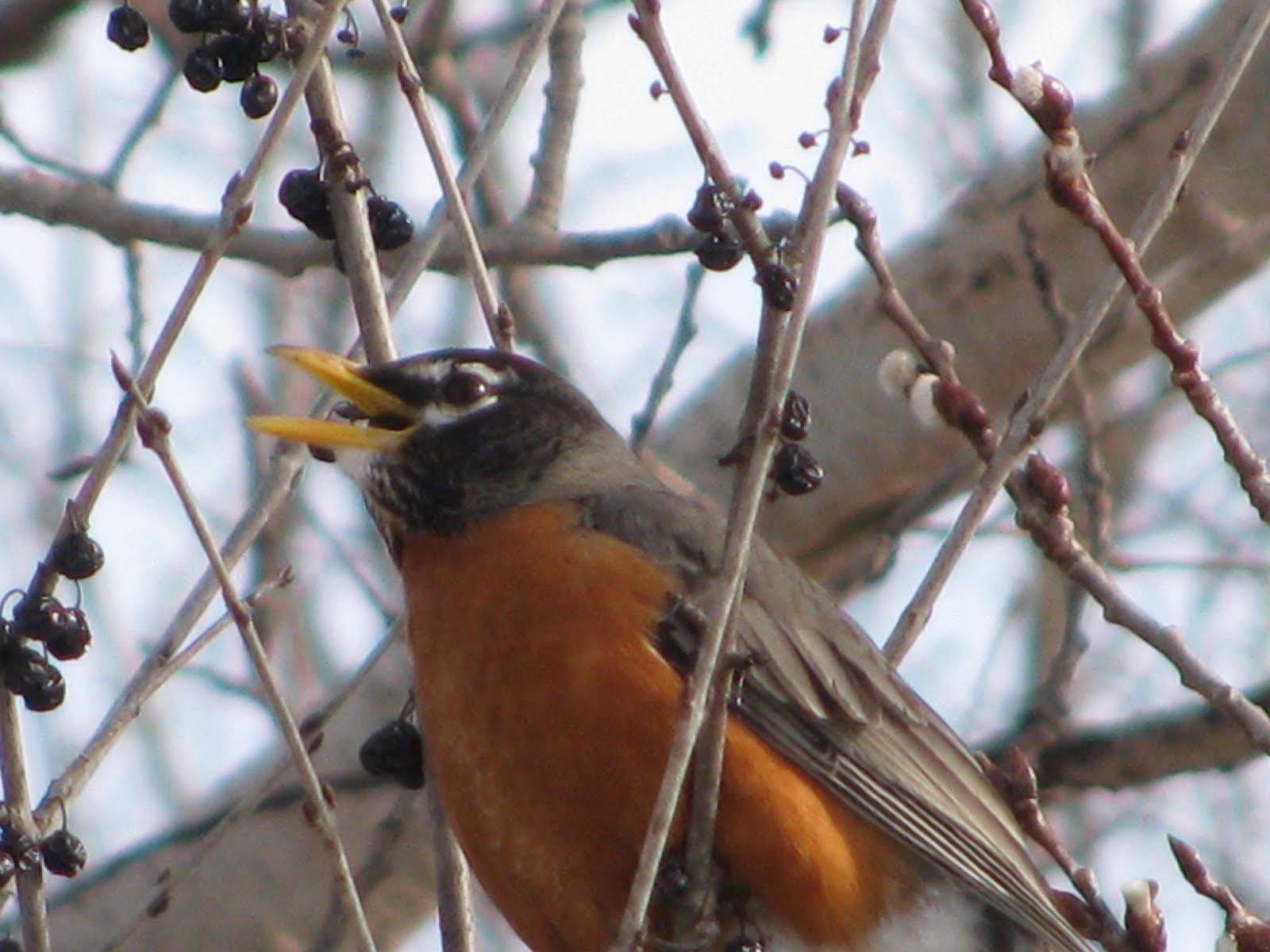
Since the last time I visited the park, most of MN had experienced some unusually warm temps for the middle of February. For close to a week, high temps remained in the 40's and even reached over 50 one day! Tons of snow have melted and you can even see the ground in some places again. The paved paths around the park were for the most part melted off and even dry today, making for easy walking again. Just after I rounded the south west corner, I spotted something in a tree only about 15 feet above the trail. At first I thought it was plastic bag until I looked closer and realized it was a Hawk. He was really close to the trail so I stayed back, trying to find a good photo angle that didn't have branches in the way. As I slowly inched closer I could really see a lot of detail in his markings and realized it was not the same type of Hawk I typically see at the park. He had a rich gray, almost blue color on his back and distinct dark bands on his tail. Eventually I got closer than I would have ever expected and snapped a couple of photos showing his bright red eyes. I had a suspicion that it was a Cooper's Hawk and after getting home and reading my field guide I think I am correct. The round shape of the tail feathers are apparently one of the few features that distinguish it from a Sharp-shinned Hawk. There were a ton of other birds out today and even the Robins were active. Maybe the warm temps last week got them thinking spring. I snapped a photo of this one eating berries off the trees. So for anyone who still thinks Robins only eat worms, here is proof of how they can survive a Minnesota winter. On the north side I got a big surprise when a group of 8 Deer popped into view walking towards me through the woods. To my amazement, 4 of the 8 were Bucks who still had their antlers! This breaks a number of records in my book -the most Bucks I've ever seen together, and definitely the latest in the season I've spotted antlers. When they spotted me, they started moving quicker into thick woods so I had to turn around and follow them, the way I'd just came from. I really wanted to get a pic with all 4 Bucks but they'd gotten too far away and too split up, so this is the best one I got. I've already been looking for antler sheds a few times this year but now I think I'd be best to wait until the end of February.