Monday, November 22, 2021

New Nature Blog

 Life has been a roller coaster in the past few years, and not necessarily in a good way. With so little time on my hands I was unable to keep this blog updated. Though I still visit Palmer Lake Park sometimes, my horizons have expanded and it's not always my first choice anymore. 

So since a lot of my birding and nature photos are from places other than Palmer, I finally did start a new nature blog in February of 2021. I had intended to add this post quite a while ago, redirecting any readers to my new blog and somehow I just totally overlooked it until now.

I can't promise this new blog will be updated any more frequently, BUT I definitely have some content here from 2021 that you might enjoy. 

Thanks!

-Travis

Sunday, January 21, 2018

Funny Ducks

It was another cold day at the park this Sunday morning. I really didn't see much until I came to the southwestern corner of the park where I could hear all the Mallards quacking even before I got there. I figured I would spend some time looking among them in hopes of maybe finding an American Black Duck which is an entirely different species. It didn't take long before I noticed an unusually dark looking duck. After seeing it's wing patch or "speculum" I could see it was missing the wide, white border that is present on Mallards. It's funny how predictable they have come to be here each winter. I am learning more all the time about Black Ducks and one thing in particular I am learning is that a high percentage of them have Mallard genes, meaning the two species commonly interbreed. In fact someone pointed out in one of these photos that there IS still the tiniest sliver of a white border on the wing patch, something that should be completely missing on a pure American Black Duck. Knowing this now, it's more apparent that the vast majority of Black Ducks I have spotted thus far have not been 100% pure American Black Duck. Maybe a few have but they would actually be the exception to the rule it seems. Whenever I do see one that I suspect has at least some Black Duck genes, I find it helpful to get a photo of them next to a regular Mallard for comparison. My second photo here shows just that. There was one other odd looking duck in the group today who seemed to possess the qualities of maybe more than two different species! One term I've learned over the years that is often used to describe such ducks is a "Manky" Mallard. Manky is a British term that generally refers to a wild duck that has bred with a domestic duck. Which is exactly what I thought I had here. BUT after sharing the photo with other bird watchers, their consensus was simply another Mallard x American Black Duck hybrid. So probably two wild ducks and not necessarily any part domestic, thus not really a "Manky" Mallard. I've found a LOT of variable ducks over the years and I find them to be a confusing yet very interesting topic. Every time I think I know what I'm looking at, I find out I'm not as versed as I think I am. Oh well, they are certainly fun to guess at! Here is an interesting online source I stumbled upon some time ago: http://www.10000birds.com/manky-mallards-domestic-feral-or-just-plain-odd-mallards.htm Later on I spent some time trying to relocate the Northern Shrike from last week but could not find it.

Monday, January 15, 2018

First of Year Northern Shrike

It was hard to find much of interest today at the park but as I came around to the north end I noticed a bird perched high up in a tree a long ways ahead of me. It kind of stuck out and caught my attention and I quickly realized it was a Northern Shrike. I feel like I used to see a lot more of them in the area and it's been some time since I've found one here. A friend of mine mentioned to me that she had been seeing one on the north side over the past couple of weeks. I took some shots and then moved closer but unfortunately the bird immediately flew off a long ways and it was the last I saw of it. Other birds seen today were common variety; Hairy Woodpecker, Black-capped Chickadee etc. I also noticed some strange looking "rainbows" on either side of the sun, something known as a Sun Dog. This is caused by the refraction of sunlight by ice crystals in the atmosphere. They seem fairly common in Minnesota winters, especially in January and February.

Wednesday, September 27, 2017

Sunset Wood Duck

Not much to write about but saw a nice female Wood Duck on the east side on the little ponds. Her plumage really showed off nice in the low sun. Also paused to photograph a Wild Cucumber fruit. These are actually native plants though they tend to creep and spread over wide areas. And I also saw a female Northern Cardinal on the east side as well. 

Monday, September 4, 2017

Labor Day Painted Lady

Today was Labor Day and I had the day off of work, though I didn't feel all that great. The previous evening I contracted a sore throat of the worst kind, but no other symptoms so I still tried to be out and about and doing things. My wife and I had hiked extensively for the past few days, visiting nearly 4 different parks in the metro area and today was kind of day to ourselves. I forgot to mention that she was also sick as of the previous day but was further along than I and wanted nothing more than to stay inside and recover. Anyway, I found myself hiking along the paved path on the north side starting at 73rd Avenue. I quickly noticed not one but two butterflies on a plant I know well; White Snakeroot. But here's the interesting part, I can't say I've EVER seen any species of butterfly on this plant. It is a native, but with it's small white flowers it generally doesn't attract much attention from pollinators, especially butterflies in my experience. But it's worth mentioning that this particular year was a "boom" year for Painted Lady Butterflies, and they are being seen by the hundreds and sometimes thousands in various parts of Minnesota this summer. Anyway, when I spotted two Painted Lady's and one Red Admiral on the same plant I just had to take some photos. Only a few hundred feet later I spotted yet more Painted Lady's again on White Snakeroot. And boy were they in perfect sunlight for photos! I think these might be the best shots I've ever gotten of this butterfly species. After sharing these on facebook, I had people with waaay more experience than I tell me that they had also seen them on White Snakeroot AND that it was the first time they'd seen that too! Since the Palmer Lake Park area doesn't support a wide variety of flowering native plants, my guess is that the Snakeroot was the best option these butterflies had for nectar. A bit later I bumped into a friend of mine and we hike together for a little bit. We spotted a Viceroy Butterfly as well but it was too far off the trail for a good photo.

Wednesday, August 23, 2017

First Migrant Bird of the Season!

August can be kind of a "dry" time for finding new birds, well at least at Palmer Lake Park anyways. Seems like all the best birds have gone somewhere else by now. The first thing that caught my eye was a Cabbage White Butterfly on the south end. It was nectaring from the tiny yellow flowers of some wild (and likely invasive) mustard. The Cabbage White is a very common and easy to find butterfly but somewhat difficult to photograph as they just never hold still. The next thing I found got me excited for birds again though; a Northern Waterthrush! This little bird is a member of the Warbler family, though you're more likely to find it on the ground near muddy banks versus up in the trees. This bird is actually already returning back south! One can see them for 2 to 3 weeks maybe in the springtime, then they are on their way further north to breeding grounds. A couple of years ago I came across another one around this same time, maybe even earlier. It's surprising how soon some birds migrate back south. Shorebirds are typically first, followed by waterfowl, but that is just a generalization and each species is different. I spent quite a bit of time following this bird around trying for a better photo, but for all my efforts this was the best I could do. Later I spotted another bird that stood out, but for my inability to identify it. Juvenile sparrows are notoriously difficult to ID, but I see some good indicators here for a young Swamp Sparrow. I'm still not 100% sure but that would be my best guess. Other birds seen today include; American Redstart (male and female) and a Gray Catbird.

Monday, June 26, 2017

Juvenile Birds

I had the day off of work today but didn't get to the park until the afternoon. I had one particular goal in mind actually and that was to find and photograph a Green Heron. It took me a while but I did end up locating one in the small pond on the east side just north of the parking lot. I had to bushwack a little while being extremely quiet and not scare the bird away, but I finally got into a good position to watch my subject for quite some time. This bird was likely a young one as evident by the whispy, white feathers on it's head that stood straight up. I've heard that Green Herons will actually catch small prey like a Dragonfly and then dip that in the water to attract a larger fish, but that behavior is something i've still yet to witness in real life. This one did seem to pull something out of the water but I couldn't tell exactly what it was. I think I watch this bird for nearly 40 minutes before he wound up on the other side of the pond in some dark shadows. A fun experience though for sure, and one that yielded some acceptable photos :) I thought I was basically done for the day but later I ended up with very close views of another young bird, this time an American Redstart. Redstarts are Warblers and notoriously difficult to photograph because the move so quickly and so frequently. But this one was so busy preening itself that it let me approach closely. At a young age, the male American Redstart looks an awful lot like an adult female Redstart. So they are often confused. But one thing to look for to differentiate them is any indication of dark patches on the face or head. Generally a female will be all grey and not show any trace of dark or black feathering here. So I think I can safely say that this is a juvenile male American Redstart.

Saturday, June 24, 2017

Three Little Birds

A lot to see today, but the highlights were a few different little birds, all showing lots of yellow color! The first was a Yellow-throated Vireo I located almost directly over the wood chip trail on the south side of the park. He (I'm assuming) was singing away which is how I came to notice him.
The light was pretty harsh and I was darn near underneath the bird so I backed up as much as I could and zoomed to make up the difference. He put on a good show for me, staying on basically the same little twig, while turning his other side to me more than once. This is the first Yellow-throated Vireo I've seen this year, and it's very possible it might be my last for the year. I just don't seem to see this species much at all and I count myself luck to see one per year. Next I spotted a bright male Yellow Warbler hopping around a Common Elderberry shrub. Having noticed the myriad of small insects attracted to the tiny, white flowers atop the plant, I'm thinking the bird was looking for bugs to eat. It was tough getting unobstructed photos of this guy when he was basically inside the plant. The third bird was also a Warbler showing a lot of yellow. This Common Yellowthroat was perched in what I think is native Red-osier Dogwood and may have been doing just the same by looking for small insects attracted to the shrub. I'm always amazed at how quickly warblers and vireos both can search individual leaves for insects. I generally only see it with binoculars but they are pretty darn good at finding the bugs or caterpillars and gobbling them down as fast as they can find them. Other sights today included; Ebony Jewelwing (damselfly), Green Heron, Great Egret, Great Blue Heron, and an Eastern Tiger Swallowtail (butterfly).

Wednesday, March 22, 2017

A Few Good Photo-ops

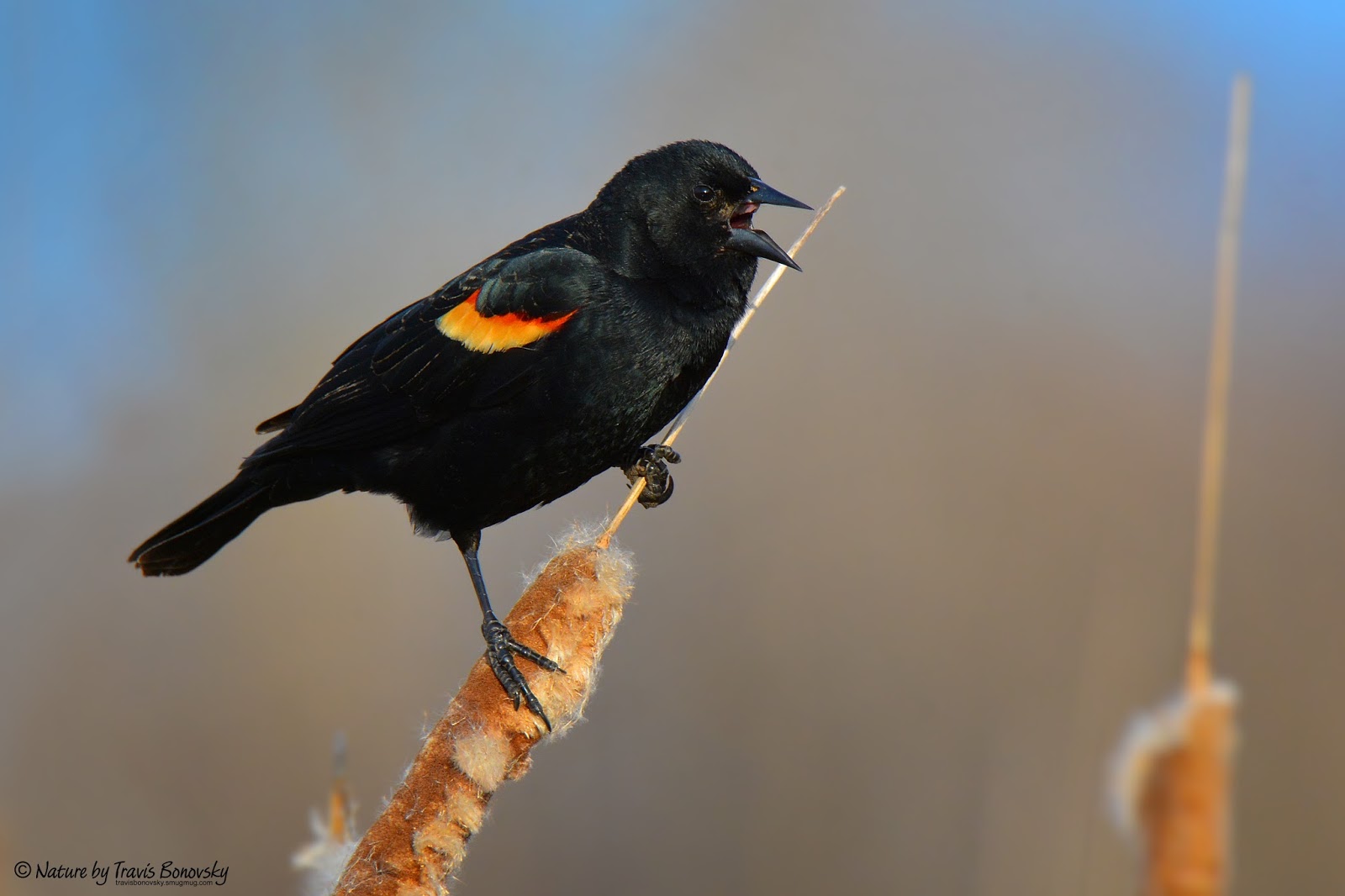
Though I heard and saw my first Red-winged Blackbirds of the year in early March, none of them have been approachable until today. I visited the park after work this Wednesday evening as there is still enough light now. I wasn't sure what to expect but as I rounded the corner from the east side into the southern end of the park I could hear Red-winged Blackbirds trilling loudly from the cattails not far off the trail. I made my way in closer, crunching on cattails and figured I would scare them away. But surprisingly this male stayed put and gave me my first good looks of the year! The light was fantastic to begin with, but as I approached closer I could see that my background was all brown cattails. I decided to kneel down and shoot upward just slightly as this angle would give me some nice blue sky behind the bird. I really love RWBB's despite how common they are. Nothing compares to hearing them in early spring and knowing that nicer, longer days are still ahead. I've not seen any females still, but it shouldn't be too long now. About 5 minutes after shooting these photos, the sun disappeared behind the clouds for the rest of the day. In fact it went from sunny and nice to almost dreary in a matter of minutes. As I hiked the wood chip trails on the southern end, I heard and saw a small number of flighty birds moving from a Dogwood shrub to the cattails and back. I first thought they were Juncos but they turned out to be American Tree Sparrows. I used to pass up on photos of this particular species because I saw them so frequently. But over the years I've come to realize they rarely give you good views and generally tend to perch in thick cover. I waited patiently for some time until one or two finally came out into the open. I didn't quite realize at the time but the colors of this bird really match it's environment here and it's no wonder they can blend in so well. I really wanted one to perch on the Red-Osier Dogwood you can see on the left side here but that never happened. As I started running out of daylight, I turned around at the duck pond and was headed back when I hear a distinct owl hoot. It sounded close but after scanning around I could not see anything. I tried following the sound and was either fooled about the direction, OR maybe I was hearing a second Owl, I'm not sure. Finally I honed in on one source long enough to make out a dark shape in a tree. I don't see Great Horned Owls often here on the south side so it was a nice surprise. As I approached many yards away, the Owl bumped from it's perch to a new one much further away. As I kept hiking it moved yet again, this time choosing to perch directly above the wood chip trail! Unfortunately it was very high up and the light had now turned ugly. I decided to take a guess at some different camera settings and I somehow managed to get something I could at least share here. It nearly looks like it's snowing out the sky is so white, but that's the camera compensating for the poor light. The Owl stayed perched here even as I walked directly underneath him and beyond. It was a memorable sighting for me.

Monday, February 27, 2017

Late February and First Red-winged Blackbirds!

I wasn't sure if I was going to make it to the park today or not. I had the day off of work but I have also been summoned for Jury Duty this week. After making my mid-day call, I learned I didn't need to report so I went for a long hike instead. Except for a few slightly cool (and average) days, today was another warmer-than-usual day for February. I believe we hit 48º or so and the sun was shining to boot. I wanted to check Shingle Creek on the north end of the park to see if any early waterfowl had returned yet, but all I found there was a lot of Mallards and a small group of Canada Geese. Shingle Creek has not been iced over for probably the entire month of February if not more, which is pretty unusual. There was also no sign of the Belted Kingfisher I spotted in the first week of this month. As I hiked around the south end of the park, I heard a familiar sound that I could not immediately place. It was a faint "chek" sound coming from my right. Then it hit me –a Red-winged Blackbird! The arrival of this bird (especially to the Palmer Lake area) each year has become an important observation as a sign of the coming Spring season. I swung around to my right, peering into the cattails and there he was! My first-of-year Red-winged Blackbird. I hiked in closer to the area in hopes of catching a better photo but it was not to be. In all of my previous years watching birds, my first RWBB's have always been spotted in March so to have seen them in February is a new record for me! As I continued on the south side I paused more than once to take in the golden light being cast over the cattails and tall grasses looking northward. This area is truly unique to find within such an urban area. In certain spots (like this one) you can forget that you are surrounded by urban sprawl on all sides. Today I was also carrying a new camera lens with me for the first time in over two years. I decided to give it a whirl on some of the Mallards in the "duck pond" on the southwest corner of the park. Both the light and the ducks were fairly cooperative so I got a few keepers. Surprisingly though I did not witness any mating behavior among them today. I guess they were too busy preening and soaking up the sun.


Sunday, February 5, 2017

A Long Walk on Superbowl Sunday

A number of years ago I remember hiking all the way to the little dam on Shingle Creek (in Brookdale Park) on Superbowl Sunday, so I decided to do it again today. After all it was a nice sunny day and the birds were fairly active. With more minutes of sunlight and warming temps the snow is melting quickly and Shingle Creek has been ice free for maybe two weeks or more. There is a drainage ditch on the northeast side of the park that generally smells horrible 90% of the year, but today there were small groups of Robins and Cedar Waxwings routinely coming to the open water for a drink. So I found a snow-free area along the ditch and just sat for a while enjoying the birds. Many Robins tend to "over-winter" here at Palmer Lake, so it's not unusual to see them this early. I caught a photo of this one right after it had a drink. Later on my hike I came to an area where Great Horned Owls nested (unsuccessfully) last year. I pulled up my binoculars and sure enough the female was using the same spot. I cannot divulge exactly where this is, as word about roosting or nesting owls spreads like wildfire and can attract photographers who might visit repeatedly and potentially stress the owl. In fact I wasn't even going to post this image, but I feel it tells an interesting phenology lesson, AND I want readers to be able to appreciate the park for the good habitat it offers some bird species. Great Horned Owls are the first birds to nest –as early as late January. Besides, the people who stalk owls likely already know about this location anyways :( Later as I was heading north, I heard the unmistakeable call of a Belted Kingfisher! I could hardly believe my ears, until I saw the bird fly over Shingle Creek to a new perch. Belted Kingfishers may also "over-winter" wherever they can find open water but this is the earliest by far I have ever spotted one in the area. Typically I wont see one here along the creek until late summer. I took a long distance photo for documentation and then attempted to get closer but was horribly unsuccessful. I could hear the bird periodically and it always sounded hundreds of feet ahead of me and eventually I lost track of it as I hiked the trail connecting to Brookdale Park. Here in Brookdale Park I spent some time watching the Mallards, and even saw a pair engaging in courting behavior of "head bobbing" as they faced each other. The pair eventually copulated which also surprised me to see so early in the year. Apparently Spring is on the way!

Sunday, January 29, 2017

Searching for Otters

It's almost the end of January, yet Shingle Creek remains completely ice free! A friend and I decided to hike the length of the creek through the park today in hopes of seeing an Otter. There have been signs of them recently, but this is one mammal I've actually NEVER seen in the wild yet. It was a sunny day but there wasn't much to be seen in the way of mammals OR birds. I did catch this photo of a Black-capped Chickadee somewhere along the way but I don't remember where exactly. Later as we were nearing the middle of the park, I noticed this funny little ice formation clinging to a stick poking up out of the creek. This is how little ice there is right now –almost unprecedented for this time of year! After searching high and low, we never did see any Otters which was unfortunate. Later we found a small group of American Robins chowing down on buckthorn berries. These are "overwintering" birds that never left for the winter. Over the years I've learned that the Palmer Lake area must provide adequate shelter and food sources for Robins and I've encountered them here in winter pretty much every season.

Saturday, January 28, 2017

Duck, Duck, Black Duck

Today was one of those rare visits to the park where I actually found what I was looking for –or somewhat expected to see. For the past few years I've been able to locate an American Black Duck or two mixed in with the Mallards in the duck pond on the southwest corner of the park. I scanned the group looking for anything darker than usual and sure enough there was one there. I shared one of these images with other bird watchers on the Minnesota Birding facebook group and some quickly pointed out that the bird was not a full fledged Black Duck, but a hybrid with a Mallard. There were a few reasons but the one that resonated most with me is that this bird actually showed some white on the edge of the speculum (blue wing patch) which shouldn't be visible on an American Black Duck. I suppose I can agree with that but for my own purposes I'm still counting this as a Black Duck versus a Mallard mostly because the bird is just waaaay darker in overall appearance, and has other Black Duck traits such as the olive colored bill. In fact in this next photo where you can see a female Mallard in the background, you can see just how different looking this bird is. Anyway, about the only other bird of interest I saw was this adult Cooper's Hawk. As a bird watcher it can be a constant challenge to differentiate Cooper's Hawks from Sharp-shinned Hawks as they tend to look so similar. I'm basing some of my ID on the fact that this bird seems to have a "dark cap" on the top of the head which stops there, whereas the dark area on a Sharp-shinned would continue down the neck. Tough to tell for sure in this particular image though. Oh, and the strange Muscovy X Mallard Hybrid was also still among the Mallards.

Sunday, January 22, 2017

An Odd Duck

Despite our recent mid-winter thaw, we've not seen the sun all weekend. I hiked around the park today with a friend but I carried my camera and binoculars just in case. We didn't really see much but we heard some Red-bellied and Downy or Hairy Woodpeckers. But we did run into a surprise at the "duck pond" on the southwest corner of the park. There were a LOT of Mallards present and I was explaining to my friend how it's sometimes worth a shot to scan the entire flock as there can be other species sometimes mixed in. In a matter of seconds my friend said "you mean like that one?" as he pointed to a darker colored and unusual looking duck. At first glance I had no idea what it was. It wouldn't be out of the question to see an American Black Duck, but this didn't look like a Black Duck at all. It was slightly larger than the other Mallards and had a kind of "lankiness" to it's appearance –like it's neck stuck out further than the other ducks. I did give me the faintest reminder of the Muscovy Duck (a domestic breed) I'd found in this same exact location in October of 2014. So now I was leaning towards some type of domestic duck. As we walked around to the other path we got to see the bird from behind and I noticed some very beautiful iridescent purple feathers and a striking emerald wing patch or "speculum" as it's called. I couldn't help but think of how similar it's plumage was to a male Wood Duck! I'd never seen anything quite like this. I figured if I got some good enough photos that I could post online later and as for help in properly identifying the bird. I believe a couple of very good birders on the Minnesota Birding facebook page nailed it. A Mallard x Muscovy Hybrid! After viewing some additional photos of said combination, I feel pretty confident that is what this bird is. You just never know what's gonna show up in the Palmer Lake Duck Pond! We also saw a few Northern Cardinals, and a pair of Great Horned Owls that were being mobbed by Crows.


Sunday, December 4, 2016

Confused Plants and Canada Goose

I wasn't seeing many birds today during my hike around the park. It's that time of year when variety of species really decreases and you are happy just to see a Mallard or Chickadee. I also saw the usual suspects including Northern Cardinal and Dark-eyed Junco. But when I came to the southwest corner I spotted a bright yellow color near the ground that made me look twice. What I saw made my jaw drop open. A rather large patch of Marsh Marigold was in bloom! This native MN wildflower typically blooms in March or April and are rather short lived in my opinion. As I busily took photos I couldn't help but notice the snow on the ground surrounding the plant. This is now officially the latest in the season I've seen this plant flower and I'm just not sure what to make of it. Could our warm and wet Fall have created just the right conditions for the plant to flower again? Or is there a larger plot to the story? I am truly amazed at nature's ability to adapt and change. I plan on sharing my find with others to get their thoughts. A short time later I found myself at the "duck pond" watching a large group of Mallards that have started to congregate here this winter. Among the many ducks was one lone Canada Goose who seemed to have something wrong with his left wing. It was noticeably low hanging, even dragging on the ground as the Goose walked. At one point he waddled down the embankment and waded into the water but did not get in and swim. I think this bum wing might have even prevented it. At this point I became more concerned and wondered how we was going to forage in the water and eat when needed. I watched him for another 30 to 45 minutes during which time it stayed mostly up on the bank, never attempting to fly or get back to the water. I wondered if I could do anything and then called a friend of mine who has experience in rescuing injured wildlife. He came with a crate while myself and another park goer named Orville (?) helped me to gradually coral the Goose away from the water and up near the paved trail. After about 40 minutes my friend was actually able to catch the goose by tossing a blanket over it and gently picking it up. We hopped in his vehicle and delivered the Goose to the Wildlife Rehabilitation Center in Roseville, one of the largest rehab clinics of it's kind in the entire United States. After a week they said I could contact them back for an update on the Goose's condition. I sure hope there is something they can do for it, but my friend made me aware that many times there is nothing they can do but euthanize the animal. Now I wasn't so sure that we did the right thing or not. But time will tell I guess.

Sunday, November 20, 2016

Nearing Thanksgiving

My visit to the park this Sunday morning included a stop at the "duck pond" on the southwest corner of the park. Mallards have already started to congregate and it makes me think of the hundreds of ducks that may be huddled here in the winter. It's always fun to stop and look through the Mallards in hopes of finding anything other than a Mallard. Kind of like "Where's Waldo." I couldn't find anything of interest but took a few photos of the green heads that I like so much. Later on the north side when I came to the bridge, I noticed the faint amber sun reflecting on the open water of Shingle Creek. It was a very pretty sight, and later when I bumped into a friend, he lamented about it as well. Interestingly I took this photo at 10:30 in the morning. Looking at it later it looks like it could near sunset. The sun is so low this time of year in Minnesota, that it never really gets overhead. My friend and I then hiked together for a while, looking around to see what we could find. To our surprise we stumbled upon a pair of Great Horned Owls, perched somewhat near other and likely a mated pair. One of the Owls flew from it's perch in no time at all. Conditions were quite dark by this time but I took some photos anyway of the other Owl. It was fun to see Great Horned's again and I'm hoping they will find a place to nest somewhere in the park this winter.