Showing posts with label Great Horned Owl. Show all posts

Wednesday, March 22, 2017

A Few Good Photo-ops

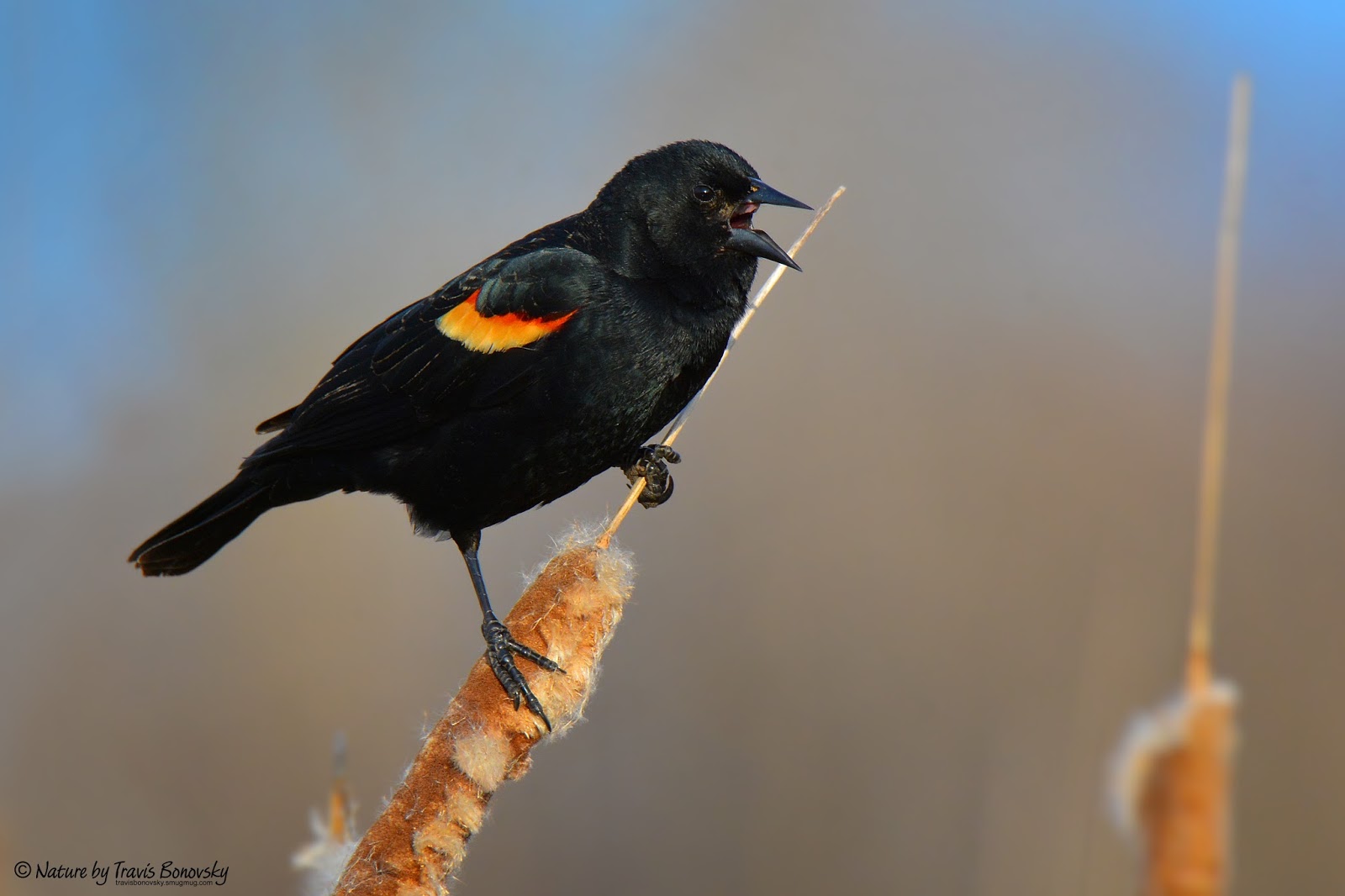
Though I heard and saw my first Red-winged Blackbirds of the year in early March, none of them have been approachable until today. I visited the park after work this Wednesday evening as there is still enough light now. I wasn't sure what to expect but as I rounded the corner from the east side into the southern end of the park I could hear Red-winged Blackbirds trilling loudly from the cattails not far off the trail. I made my way in closer, crunching on cattails and figured I would scare them away. But surprisingly this male stayed put and gave me my first good looks of the year! The light was fantastic to begin with, but as I approached closer I could see that my background was all brown cattails. I decided to kneel down and shoot upward just slightly as this angle would give me some nice blue sky behind the bird. I really love RWBB's despite how common they are. Nothing compares to hearing them in early spring and knowing that nicer, longer days are still ahead. I've not seen any females still, but it shouldn't be too long now. About 5 minutes after shooting these photos, the sun disappeared behind the clouds for the rest of the day. In fact it went from sunny and nice to almost dreary in a matter of minutes. As I hiked the wood chip trails on the southern end, I heard and saw a small number of flighty birds moving from a Dogwood shrub to the cattails and back. I first thought they were Juncos but they turned out to be American Tree Sparrows. I used to pass up on photos of this particular species because I saw them so frequently. But over the years I've come to realize they rarely give you good views and generally tend to perch in thick cover. I waited patiently for some time until one or two finally came out into the open. I didn't quite realize at the time but the colors of this bird really match it's environment here and it's no wonder they can blend in so well. I really wanted one to perch on the Red-Osier Dogwood you can see on the left side here but that never happened. As I started running out of daylight, I turned around at the duck pond and was headed back when I hear a distinct owl hoot. It sounded close but after scanning around I could not see anything. I tried following the sound and was either fooled about the direction, OR maybe I was hearing a second Owl, I'm not sure. Finally I honed in on one source long enough to make out a dark shape in a tree. I don't see Great Horned Owls often here on the south side so it was a nice surprise. As I approached many yards away, the Owl bumped from it's perch to a new one much further away. As I kept hiking it moved yet again, this time choosing to perch directly above the wood chip trail! Unfortunately it was very high up and the light had now turned ugly. I decided to take a guess at some different camera settings and I somehow managed to get something I could at least share here. It nearly looks like it's snowing out the sky is so white, but that's the camera compensating for the poor light. The Owl stayed perched here even as I walked directly underneath him and beyond. It was a memorable sighting for me.

Sunday, February 5, 2017

A Long Walk on Superbowl Sunday

A number of years ago I remember hiking all the way to the little dam on Shingle Creek (in Brookdale Park) on Superbowl Sunday, so I decided to do it again today. After all it was a nice sunny day and the birds were fairly active. With more minutes of sunlight and warming temps the snow is melting quickly and Shingle Creek has been ice free for maybe two weeks or more. There is a drainage ditch on the northeast side of the park that generally smells horrible 90% of the year, but today there were small groups of Robins and Cedar Waxwings routinely coming to the open water for a drink. So I found a snow-free area along the ditch and just sat for a while enjoying the birds. Many Robins tend to "over-winter" here at Palmer Lake, so it's not unusual to see them this early. I caught a photo of this one right after it had a drink. Later on my hike I came to an area where Great Horned Owls nested (unsuccessfully) last year. I pulled up my binoculars and sure enough the female was using the same spot. I cannot divulge exactly where this is, as word about roosting or nesting owls spreads like wildfire and can attract photographers who might visit repeatedly and potentially stress the owl. In fact I wasn't even going to post this image, but I feel it tells an interesting phenology lesson, AND I want readers to be able to appreciate the park for the good habitat it offers some bird species. Great Horned Owls are the first birds to nest –as early as late January. Besides, the people who stalk owls likely already know about this location anyways :( Later as I was heading north, I heard the unmistakeable call of a Belted Kingfisher! I could hardly believe my ears, until I saw the bird fly over Shingle Creek to a new perch. Belted Kingfishers may also "over-winter" wherever they can find open water but this is the earliest by far I have ever spotted one in the area. Typically I wont see one here along the creek until late summer. I took a long distance photo for documentation and then attempted to get closer but was horribly unsuccessful. I could hear the bird periodically and it always sounded hundreds of feet ahead of me and eventually I lost track of it as I hiked the trail connecting to Brookdale Park. Here in Brookdale Park I spent some time watching the Mallards, and even saw a pair engaging in courting behavior of "head bobbing" as they faced each other. The pair eventually copulated which also surprised me to see so early in the year. Apparently Spring is on the way!

Sunday, November 20, 2016

Nearing Thanksgiving

My visit to the park this Sunday morning included a stop at the "duck pond" on the southwest corner of the park. Mallards have already started to congregate and it makes me think of the hundreds of ducks that may be huddled here in the winter. It's always fun to stop and look through the Mallards in hopes of finding anything other than a Mallard. Kind of like "Where's Waldo." I couldn't find anything of interest but took a few photos of the green heads that I like so much. Later on the north side when I came to the bridge, I noticed the faint amber sun reflecting on the open water of Shingle Creek. It was a very pretty sight, and later when I bumped into a friend, he lamented about it as well. Interestingly I took this photo at 10:30 in the morning. Looking at it later it looks like it could near sunset. The sun is so low this time of year in Minnesota, that it never really gets overhead. My friend and I then hiked together for a while, looking around to see what we could find. To our surprise we stumbled upon a pair of Great Horned Owls, perched somewhat near other and likely a mated pair. One of the Owls flew from it's perch in no time at all. Conditions were quite dark by this time but I took some photos anyway of the other Owl. It was fun to see Great Horned's again and I'm hoping they will find a place to nest somewhere in the park this winter.

Saturday, March 5, 2016

First of Year Wigeon!

It was a very nice day on Saturday to visit the park. There is still a bit of snow on the ground in the shade and it being very early March, I didn't expect to see much today. For whatever reason, I decided to hike upstream along Shingle Creek from the foot bridge on the north side. I had barely gone 50 feet when there right in front of me came swimming an American Wigeon! This is a unique and beautiful duck if you can get close to one. And that is usually the problem. They are typically seen far out in the water and can be quite skittish. But that certainly was NOT the case with this one! This little duck (about 3/4 the size of a Mallard), was not shy in the least and didn't really mind my presence at all. It was a rare photographic opportunity that I wasn't about to miss out on. I followed the Wigeon slowly along the creek, moving up and back where he finally decided to jump up on the grass bank and preen himself among the Mallards. As I watched him he was noticeably assertive, even aggressive and would nip at any Mallard that came too close to him! I bet I watched him and took photos for over an hour, even calling a friend who came and met me at the park. It still feels early to be seeing new waterfowl so this was quite a special find. For some of these photos I laid flat down on my stomach on the wet grass trying to get as low an angle as I could. I'm guessing the Wigeon was a male based on the fairly colorful plumage, especially the green eye stripe. But I'm also thinking he wasn't quite in full breeding plumage yet as the green would have probably been even more bright and obvious. After sharing my photos on the Minnesota Birding facebook page, someone referred to him as a "Baldpate" which is a nickname for the duck based on it's white colored forehead. After this find I was quite pleased and really didn't try very hard for other birds. After all it was still early and very few migrants have returned yet anyways. My friend Ron enjoyed seeing the Wigeon as well and afterwards we hiked a little bit on the north side to see the Great Horned Owl reported nesting in a big Cottonwood tree. This was pointed out to me by another nature enthusiast some weeks ago and I highly doubt I would have spotted this on my own. Typically, Great Horned Owls nest in abandoned Squirrel nests. But this one chose the crook of a large tree which I think had a little depression. I have never seen an Owl nest in such a way, and the tree was so far from the trail, that one would have a hard time even seeing the Owl. We saw no sign of the male at all, though there are a lot of other large trees in the area where he could be roosting. I will have to check back periodically on this nest to see if it is successful. If it is, it will be interesting to see how the chicks manage this small space together with mom. Later the same day I actually stopped back to watch the Wigeon some more. I found him further upstream on the bank again but the low light was terrible and I only managed a few more photos worth saving. Oh yeah, I have to add this. A pair of Mallards were mating just below the bridge. Quite a sight!


Saturday, January 16, 2016

A Cold Walk with Good Sights

The temperature today when I arrived at the park was 0º but at least there was no wind and the sun was shining. I hadn't walked real far and was on the south wood chip trails when a large raptor suddenly burst out above me. It was a Great Horned Owl and I was surprised to see one in this area of the park. I watched to see vaguely where it re-perched and went back the way I came in hopes of a photo. Eventually I did find it again but it was now facing away from me and much higher up. I wondered if a pair were scoping out nesting areas here but I found no evidence of that. Later when I was hiking near the duck pond I noticed quite a few Robins hanging out near the little patch of open water that rarely freezes –even in zero degree weather. As I was watching them I noticed one that looked the wrong color. Then it bobbed it's tail repeatedly, making me look closer. To my shock it was a Hermit Thrush! This is a bird I typically see in late Fall (November) or early Spring (April), but I've never seen one in January! I kept an eye on him but it was hard as he blended right into the patchy shoreline of brown leaves and spots of snow. Gradually he moved into a nice sunny spot and just stayed there while I took photos. When I got home I reported this bird over ebird.org and sure enough it was listed as "rare" for this time of year! Only my second real "rare bird" report since I started using ebird. I decided to back to the open water and get down nice and low for some closeup views of the Robins. I'm very glad I did as I walked away with a couple of photos I'm proud of –even if it is of a very common species. Actually I always like sharing photos of Robins in the winter, as many Minnesotan's tend to think of them returning in the Spring. What actually happens is that while the majority of Robins DO migrate south, a certain percentage will stay all winter in areas where they have access to food and water. This behavior is referred to as "overwintering" and a great deal of Robins happen to choose Palmer Lake Park as their place. I also think it's fun to try and catch them (or any bird for that matter) bending over to drink. Nearly all birds except for Doves and Pigeons have to lap up water and then tilt their head back in order to actually drink. I read once before that it has something to do with their nasal cavities and they don't have the ability to "suck up" the water. Interesting huh? I also spent some time watching the Mallards in the duck pond doing exactly the same thing. It's always nice to see their beautiful green heads shining in the sun on a cold winter day. One other bird I got close to today was this male Downy Woodpecker (as evident by the patch of red on the back of his head). He was so busy hammering away on this branch that he let me sneak up within mere feet and snap some photos. I also saw Hairy Woodpeckers, and a domestic cat roaming out in one of the fields.

Saturday, March 7, 2015

Finally Above Freezing!

I heard on the news yesterday that March 6th, was our first day above freezing in 25 days! This winter has run it's course for most by now and I like many people, have rampant Spring Fever. It was already 31 or 32º by early morning but I decided to wait for things to warm up even more before going to the park. A friend of mine wanted to come walking with me today so we met around 10:30am. I knew we would probably spend more time talking and less time bird watching but I brought my camera just in case. You could hardly pay me not to take it along with me to an area where I might see birds. It was sunny with blue skies, but the strong wind actually made it feel much cooler. We did see a number of birds on our hike around the park and the ones seen most often were Black-capped Chickadees. This one posed ever so briefly for a photo against the clear blue sky. We also noticed a good amount of Northern Cardinals, an occasional Dark-eyed Junco and lots of Mallards flying overhead. The duck pond was virtually empty when we got there, making me think they all took off for the river instead. Near the bridge over Shingle Creek on the north side, a White-breasted Nuthatch paused for quite a while on the side of a large tree. I watched him look upward and blink a few times but other than that he appeared glued to the tree. This was one of about 5 WBNH's we saw today. Later we paused briefly to gaze at a nesting Great Horned Owl who was swaying back and forth in the strong wind. I took a few quick photos and when I got home to process them, I noticed something else in the nest with her. A second set of ears were there, only these were not Owl ears. It was in fact a rabbit that the male had likely brought in as a meal. There was no sign yet of any Owlets but it can be hard to tell sometimes until they are larger and crowding the nest. I hope it's not so breezy tomorrow.

Sunday, March 1, 2015

Meteorological First Day of Spring

For the purposes of this blog, I had decided –out of instinct– to make generalized cut-off points at the beginning or end of various months to indicate the four seasons of Spring, Summer, Fall and Winter. Little did I know at the time but this is a real method of demarcating the seasons and is called "meteorological reckoning." In this scenario today March 1st would be the 1st day of Spring. I chose this method because I thought it seemed to fit much better with the arrival, departure and general behavior of the birds in our region. For example the Hermit Thrush typically arrives back in Minnesota while there is still snow on the ground. But I wouldn't call a Hermit Thrush a "winter bird." Even hearty Warblers like the Yellow-rumped Warbler can begin arriving earlier than the official first day of Spring. My two favorite sayings and generalization about birds are; a) Birds don't read field guides, and b) Birds don't read calendars! I've come to find both of these very true. So there's my explanation for that. Now on to my hike around the park today! The first thing I stopped to take a photo of was a male Great Horned Owl that was perched surprisingly close to the trail. He was obviously tending to his nesting mate and is the same one I've been seeing frequently. It was nice to see him in such good light for a change. As I walked I noticed that many of the dried up Oak leaves still clinging to their trees from last season are now starting to drop. One more sure sign of the changing season. Later I made a brief trek into the woods and scared up a flock of a dozen or so Mourning Doves. You'll know Mourning Doves immediately because their wings make an unmistakeable noise when they first burst into flight. I stepped further quietly hoping to find one still perched and noticed this one between a small gap in the thick branches. I know for certain that Mourning Doves stay the entire winter in the Palmer Lake Park area. If you would draw a horizontal line across the bottom 1/3 of the state, this is roughly their year-round territory. Shortly after I could hear a Northern Cardinal singing loudly and continuously. Indeed I have heard Cardinals "call" and maybe even "sing" for brief periods this winter, but this was noticeably different in that it was continuous and cheerful. It seemed so out of place that it made me stop to think when the last time I'd witnessed a Cardinal doing so. Likely not since springtime. How could one not feel joy at such a sight? Other birds spotted today included; Dark-eyed Junco, Red-bellied Woodpecker, Hairy Woodpecker and lots of Black-capped Chickadees.

Saturday, February 28, 2015

Last Day of February 2015

The original title for this post was going to be "where are all the birds?" as it was an unusually quiet day at the park for wildlife. Though there wasn't a cloud in the sky and the sun is at a much higher angle now, you wouldn't know by the temperatures that March starts tomorrow! Our high for today was around 18 or 19º and it's still windy enough to feel much lower. I heard on the news this evening that we haven't been above 30º in over 3 weeks! I'd barely seen or photographed any birds until I got to the north side. Even the duck pond was nearly empty save for about 10 Mallards huddled up under the eroding bank. My best birds of the day were probably a pair of Red-bellied Woodpeckers calling loudly back and forth. This one is the female with her red crown stopping halfway up her head as opposed to the male who's red crown goes all the way up to his beak. I'd hiked into the woods a little ways to find the Woodpeckers and to my surprise I scared up a Great Horned Owl. This would have been the male who is tending to his nesting mate. I thought I was far enough away from the nest to bump into him but apparently not. I didn't see where he landed again until I'd walked a ways past the nest in the other direction. Then I noticed him again right from the paved trail. His eyes were glowing yellow even though the sun was more or less behind him. Near the end of my walk I finally started seeing a few other birds including Northern Cardinals, Dark-eyed Juncos, American Robins, Black-capped Chickadees and Downy Woodpeckers. The Downy's seemed completely oblivious to my presence today and had I wanted to, I could have reached out and touched more than one of them. They were so close to me that I had to back up in order to get them in my viewfinder. I watched them for quite a while as the hammered away at various twigs and vines looking for a tasty morsel. Being so close I really got a new appreciation for just how small of birds they are. This was my favorite photo of them all mostly because of the blue sky behind the bird.

Sunday, February 15, 2015

Great Backyard Bird Count 2015 (Sun)

On day 2 of my Great Backyard Bird Count, I certainly felt like I saw more species. At the time of my hike it was near 8 or 10º above which definitely felt warmer than yesterday. And thank goodness the wind had subsided. The park felt more active for wildlife today and I was seeing Downy and Hairy Woodpeckers left and right. There were also a fair amount of Cardinals active today and both male and female were visible. As I exited the wooded area from the north side heading west, a Red-tailed Hawk flew right past me. This is in the area where I've seen 2 of them this winter but after looking around for a bit I could not find another. On the south side at the duck pond the open water has shrunken yet more in size forcing more Mallards to find water elsewhere. There's still good numbers of them here thought that I'd estimate at 70 to 75. On the wood chip trail here I took particular interest in both a White-breasted Nuthatch and another Downy Woodpecker. The Downy was in a bush of Red-osier Dogwood and busily pecking at it's thin twigs. I crept up on it and took a few successive photos in burst mode. When I got home I was surprised to find that I'd captured the very moment when it pulled some kind of insect larva from the shrub! Essentially this happened within 3 frames I'd taken at 6 frames per second –meaning it found and pulled the larva in about one half a second. I find it incredibly interesting how skilled Woodpeckers are at finding and extracting something like this during the height of winter. Quite amazing. Further along I found a male Great Horned Owl standing guard near his now nesting mate. This big, snapped off tree wasn't exactly the place I would expect to see an Owl perch. He looked kind of like a king on a throne up there. The light here was terrible and I shot through a lot of brush for the photo and it turned out pretty grainy. My last good sighting of the day was quite a good one for many reasons. I was hiking on the wood chip trail heading towards where Shingle Creek empties back out of the lake. I was about to turn the corner at the creek when I thought I saw some wadded up old newspaper caught in a tree down near the frozen creek. Upon closer inspection it was a small raptor! Because of the birds vibrant orangey tone, I firs thought it was an American Kestrel –which is our smallest species of Falcon. But the face didn't seem right. At the point of noticing the bird I was already only 30 feet away. As I stood there taking photos the bird hadn't really paid me any attention so I approached a bit closer, hiking down the creek bank and half way out onto the frozen water. At this distance I was more skeptical and my only other thought is that it was a Merlin. A Merlin is also a Falcon but slightly larger and slimmer than a Kestrel. I have only seen a Merlin once before in the Palmer Lake Park area, but I did have a good opportunity to view another wild one last fall at Hillside Cemetery in North Minneapolis. That one had a much more distinct "mustache" our dark, vertical markings extending down from the front of the eye. This bird did not really show that and also showed a fairly bright "blueish" colored cap on it's head. I posted the photo to the Minnesota Birding Facebook page and learned that it is a known subspecies of Merlin called the "Prairie Merlin or Richardson's Merlin!" I don't think I would count this as a new species for the park but it is certainly interesting to note! According to the Cornell Lab of Ornithology, the Prairie Merlin subspecies occurs in Great Plains states and southern Canada.

Saturday, February 14, 2015

Great Backyard Bird Count 2015 (Sat)

A few years ago I started a tradition of making sure to participate in the annual Great Backyard Bird Count or "GBBC" every February. At the time I guess I didn't quite realize that it's kind of a marketing scheme to get bird watchers to start using an online reporting tool called ebird. Not implying anything negative by that, it's just that when I did my first count I hadn't realized the tool already existed before I heard about the GBBC. In fact ebird is setup to allow you to report on a daily basis and for multiple locations including your own back yard. Anyhow, I think this is the 3rd or 4th year that I've made sure to pay more attention to what I'm seeing at the park and report it online when I get home. Last year my goal was to find a Northern Shrike to report. This year my goal was to report at least one Owl. I was joined by another good birder friend of mine today and we made our way around the entire perimeter before doing some off the trail hiking as well. The temperature at the time was roughly 0º and it was quite windy on top of it. It was hard to dress warm enough and my face was numb within minutes. Our first stop was at the duck pond where we could see that the area of open water had shrunk nearly in half from it's previous size. I estimate there were about 80 Mallards here today and there was barely enough room for them in the water. No sign of a Black Duck or anything else unusual but it was interesting to watch how they managed the cold weather. Most had their head tucked back and were covered in ice crystals. Despite the temps it was completely sunny out today so when we got out of the wind it was more tolerable. Birds were expectedly not very active today save for a few Robins, Cardinals, Chickadees and Hairy Woodpeckers. Having spotted one Great Horned Owl already, we spotted two more later on –a pair using a reconstructed Cooper's Hawk nest that I played a part in back in July of 2012. I wont say exactly where this is in the park to avoid extra attention as I know that dedicated bird watchers will find this on their own sooner or later. Much later on we ran into another birder friend of ours who stated that he just saw a Barred Owl fly through the woods. At first we were unsuccessful in relocating it and were about to give up. But when we hiked into the woods a little ways to see if we could get closer to some Cardinals and House Finches, there it was! I was quite happy to report a total of 4 Owls and 2 different Owl species to the GBBC. I plan on doing the same again tomorrow.

Saturday, January 24, 2015

43º and Sunny and Birdy

This Saturday's visit to the park was a fun one. First off the weather was unbelievable with a high of 43 degrees and completely sunny to boot. Secondly I was able to catch some neat photos which always makes my day! The very first bird I spotted was a Dark-eyed Junco and I'm kind of obsessed with them though they're a pretty common winter bird in our parts. They're difficult to photograph because they're little, move quickly and have a dark head against a dark eye. For that reason they're similarly difficult to shooting a Chickadee. This one cooperated with me though there's some shadows on it's face that I could have done without. My next stop was at the duck pond on the southeast corner. The warm weather seemed to please the Mallards and the large group was very active. I witnessed some courting behavior and some fighting between the boys as well. I really love how their green heads just glow in the sun and I've come to appreciate Mallards as an easy and reliable photo subject. After seeing a few Chickadees and Cardinals and other common birds, I spotted not one but two Great Horned Owls high up in a tree. They were both quite far away with lots of woods between so I decided not to go in any closer. It wont be long now before one of these pair will be sitting on a nest somewhere. Great Horned Owls are our earliest nesting birds in the state, starting as early as mid to late January. When this happens we birders need to take extra precaution not to approach the nesting sight or disturb them in any manner that could be a detriment to the success of their nest. Having seen two Owls already today, I nearly fell over when I ran smack dab into a third, this time a Barred Owl! A Barred is likely our second-most common Owl around central Minnesota, but they can be as tough as any of the other Owl species to find. This one however decided to perch barely 10 feet off the paved trail and at a height of only 6 or 7 feet! I was stunned to have been so close to it. I stopped dead in my tracks and cautiously brought my camera up to my eye. Thankfully the Owl appeared a bit sleepy and was taking advantage of the warm sun and really didn't mind me being there –at least for now. I couldn't take my eyes –or my camera– off this beautiful bird and of course I started to draw attention from other park goes. The first one stopped to inquire about my camera and lens. Interesting she never asked me what I was taking a photo of and thus I decided not to even bring it up! The next pair of walkers were more curious and so I pointed out the Owl to them. They were quite happy and surprised to see it as well. As we talked however the Owl did move, though it only went a few feet over and higher up in another tree. I was kind of bummed and wish I had whispered to them instead. Nonetheless the Owl was still very close to the trail and I took a few more photos before it decided to move further back into the woods. I believe this was my third Barred Owl sighting this season which is a good sign. Previous to these recent encounters, my last Barred sighting was in May of 2013. The last avian subject I decided to focus on today were Robins. These Robins are not coming back to Minnesota due to the warm temps, but rather have "over wintered" here at the park. Not all Robins migrate south and quite a few will stay here all winter long. This number appears to be increasing based on other things I've read. There apparently are enough food sources and shelter to see them through event the coldest of winters. Though this winter has been a little light in regards to snow depths and I believe this would also be to the Robin's benefit. I enjoy photographing them in the winter, though I rarely pay attention to them the rest of the year! Other birds I spotted today included; Downy, Hairy & Red-bellied Woodpecker, Cedar Waxwing and a pair of Red-tailed Hawks.

Saturday, January 17, 2015

January Thaw

After a long and brutal cold snap, we are finally above freezing again and even the sun came out this morning! It was a great day to be at the park hiking around and seeing what could be seen. It was so nice I inadvertently did the southwest side of the park twice. On the first round I noticed a few little birds hopping about in front of me in the shade. Upon closer inspection they were Goldfinch in their winter plumage. I think there were only 2 or 3 at the most but I like to see them in the winter time. Shortly afterward I stopped at the duck pond and noticed a group of a dozen or so Cedar Waxwings bathing in the open water along the bank. This was on the other side from me so I walked around to get closer and scared them off. But after a bit they started to come back one by one and were putting on quite a show. I wished I could have got even closer but it was so thick here. While watching the Waxwings I heard all the Mallards in the duck pond making noise all at once and move quickly in a large group. When I looked up I noticed a Hawk had just swooped over the group of ducks and perched on the opposite side of the pond. It looked to be a Cooper's Hawk but was in the dark shade. I wanted to get a closer look and immediately headed around to the other side, trying not to bump the raptor. To my surprise it stayed put, perched nearly at eye level with me. As I snuck around the back side I finally got into better light and could see bright yellow eyes –indicating a juvenile bird. A mature adult would have bright red eyes. I took quite a few photos from this angle assuming it was a Cooper's Hawk but upon processing the photo I am starting to think it might actually be a Sharp-shinned Hawk. Sharp-shinned Hawks are nearly identical in plumage but tend to have a smaller head, more square-ish looking tail, and be somewhat smaller in size. Though the larger female Sharp-shinned can be nearly the same size as the smaller male Cooper's Hawk, adding yet another layer of complexity to identification. Only last year I learned how to differentiate a Cooper's from a Sharp-shinned in flight, but perched is another story. I generally err on the side of Cooper's since they are apparently far more common to find perched among the woods. But this one really made me look more than once. I am posting to the Minnesota Birding facebook page for some help and should have a positive ID soon. If indeed it turns out to be a Sharp-shinned, it would be my first ever photo ID of one! Upon walking the woodchip trail away from the duck pond, I scared up a Great Horned Owl almost right above me! I stopped in my tracks and said a few choice words to myself as I would have likely gotten a great look at it in the full morning sunlight. The bird flew a fair distance but basically traveled in a straight line away from me. I could kind of make out where it perched and followed behind, trying not to look up toward it too often. I've noticed from experience that they tend to bump again quickly if you stare them down as opposed to just looking at the ground. In fact I've come much closer to Owls when I wasn't looking for them and just happened to look up to find one right above me. As I headed closer it moved yet again and was followed by a second Owl close behind. The pair chose a familiar roost I've seen them at before. The pair is likely scoping out a possible nest as Great Horned Owls will begin nesting somewhere between late January through February.

Saturday, January 10, 2015

Don't Bump the Lump

After a long hike around MAC Park near the Crystal Airport this morning, I somehow found enough energy yet to visit Palmer Lake Park. I didn't arrive until after 3:00pm and with our short daylight hours I knew I only had roughly an hour. Therefore I parked on the south side and hiked only along the south and west edges of the park. Here I found Robins a plenty. I often see them come down to the open water between the duck pond and the adjacent body of water where the culvert connects them underneath the trail. The water here stays open all year long and provides a good place for all birds to drink from. This particular Robin had already taken his drink and backed up a little on the ice. I really like the way the blue ice contrasted with the orange breast of the bird. Along the paved trail on the far west side I ran into a small group of American Tree Sparrows and this one sat still long enough for me to get in closer for a photo. This photo turned out to show a good representation of all of the characteristics that would help you identify the bird as an American Tree Sparrow. First you have a noticeable rusty-colored crown butted up to a rather gray colored face. Then there's the tell-tale –but not always obvious– dark spot in the middle of the white breast. And lastly, what I find to be the most definitive characteristic is the two-toned bill (dark upper bill and lighter/yellow lower bill). On my way back I noticed a large, dark "lump" up in a tall Cottonwood tree that didn't seem like part of the tree. It's hard to spot Owls but to be honest that is what I look for –unusual looking "lumps" high up in the trees. By now it was getting dark and I know how terrible it can be to get a photo at this time of day –especially looking upward into the white sky. So I cranked up the ISO settings as well as adjusted the exposure compensation before even attempting to walk closer to the "lump." I was glad I did though as I was fortunate that the lump did not "bump" which is bird-geek talk for flying away. I thanked the Great Horned Owl and walked slowly back to where I came from which is somewhat of a rare occurrence as they do tend to fly away more often than not once they realize you are watching them.