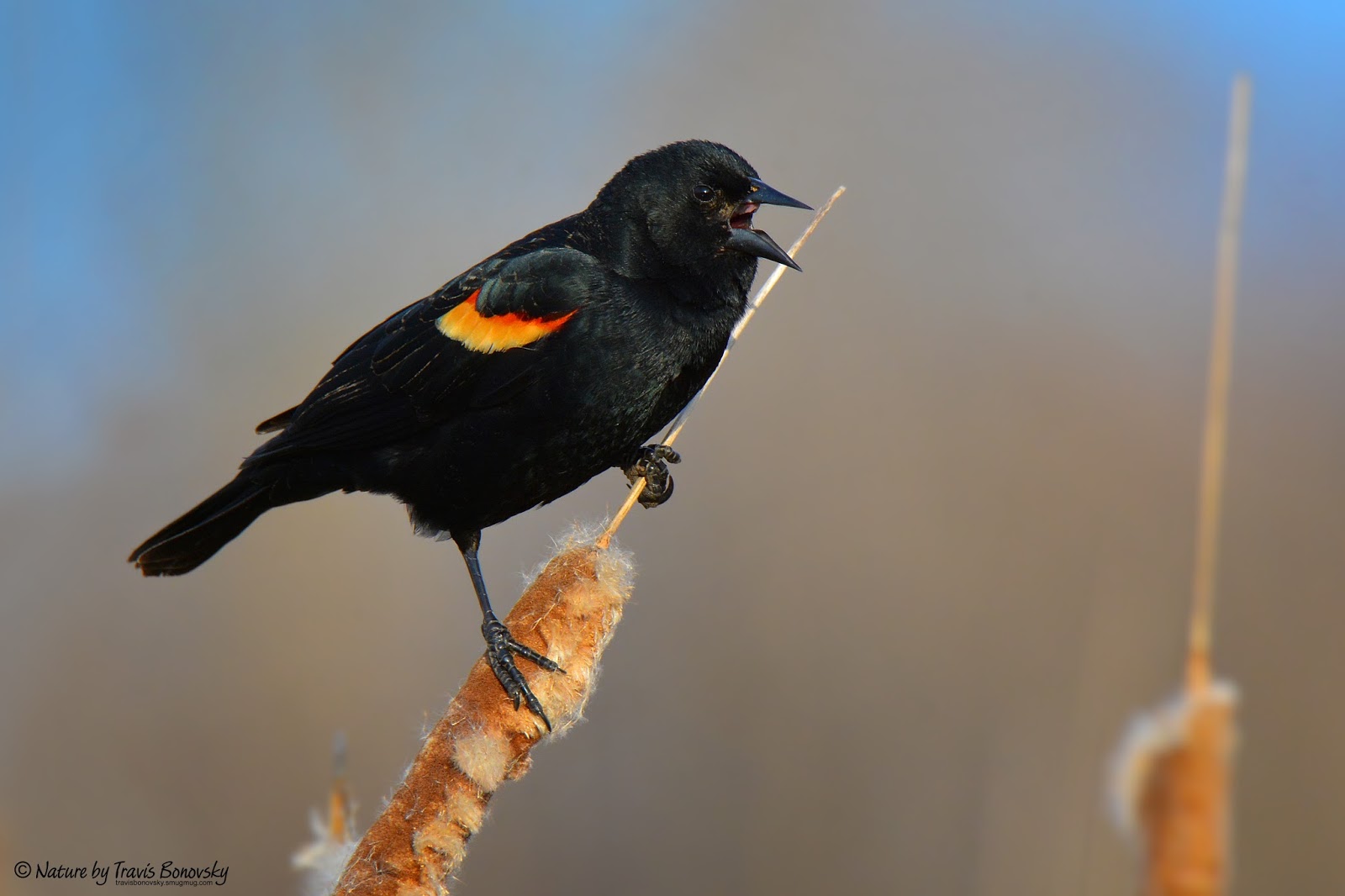
Though I heard and saw my first Red-winged Blackbirds of the year in early March, none of them have been approachable until today. I visited the park after work this Wednesday evening as there is still enough light now. I wasn't sure what to expect but as I rounded the corner from the east side into the southern end of the park I could hear Red-winged Blackbirds trilling loudly from the cattails not far off the trail.

I made my way in closer, crunching on cattails and figured I would scare them away. But surprisingly this male stayed put and gave me my first good looks of the year! The light was fantastic to begin with, but as I approached closer I could see that my background was all brown cattails.

I decided to kneel down and shoot upward just slightly as this angle would give me some nice blue sky behind the bird. I really love RWBB's despite how common they are.

Nothing compares to hearing them in early spring and knowing that nicer, longer days are still ahead. I've not seen any females still, but it shouldn't be too long now. About 5 minutes after shooting these photos, the sun disappeared behind the clouds for the rest of the day. In fact it went from sunny and nice to almost dreary in a matter of minutes. As I hiked the wood chip trails on the southern end, I heard and saw a small number of flighty birds moving from a Dogwood shrub to the cattails and back. I first thought they were Juncos but they turned out to be American Tree Sparrows. I used to pass up on photos of this particular species because I saw them so frequently. But over the years I've come to realize they rarely give you good views and generally tend to perch in thick cover.

I waited patiently for some time until one or two finally came out into the open. I didn't quite realize at the time but the colors of this bird really match it's environment here and it's no wonder they can blend in so well. I really wanted one to perch on the Red-Osier Dogwood you can see on the left side here but that never happened. As I started running out of daylight, I turned around at the duck pond and was headed back when I hear a distinct owl hoot. It sounded close but after scanning around I could not see anything. I tried following the sound and was either fooled about the direction, OR maybe I was hearing a second Owl, I'm not sure. Finally I honed in on one source long enough to make out a dark shape in a tree. I don't see Great Horned Owls often here on the south side so it was a nice surprise. As I approached many yards away, the Owl bumped from it's perch to a new one much further away. As I kept hiking it moved yet again, this time choosing to perch directly above the wood chip trail! Unfortunately it was very high up and the light had now turned ugly.

I decided to take a guess at some different camera settings and I somehow managed to get something I could at least share here. It nearly looks like it's snowing out the sky is so white, but that's the camera compensating for the poor light. The Owl stayed perched here even as I walked directly underneath him and beyond. It was a memorable sighting for me.
 I've heard that Green Herons will actually catch small prey like a Dragonfly and then dip that in the water to attract a larger fish, but that behavior is something i've still yet to witness in real life. This one did seem to pull something out of the water but I couldn't tell exactly what it was. I think I watch this bird for nearly 40 minutes before he wound up on the other side of the pond in some dark shadows. A fun experience though for sure, and one that yielded some acceptable photos :) I thought I was basically done for the day but later I ended up with very close views of another young bird, this time an American Redstart. Redstarts are Warblers and notoriously difficult to photograph because the move so quickly and so frequently.
  But this one was so busy preening itself that it let me approach closely. At a young age, the male American Redstart looks an awful lot like an adult female Redstart. So they are often confused. But one thing to look for to differentiate them is any indication of dark patches on the face or head. Generally a female will be all grey and not show any trace of dark or black feathering here. So I think I can safely say that this is a juvenile male American Redstart.